
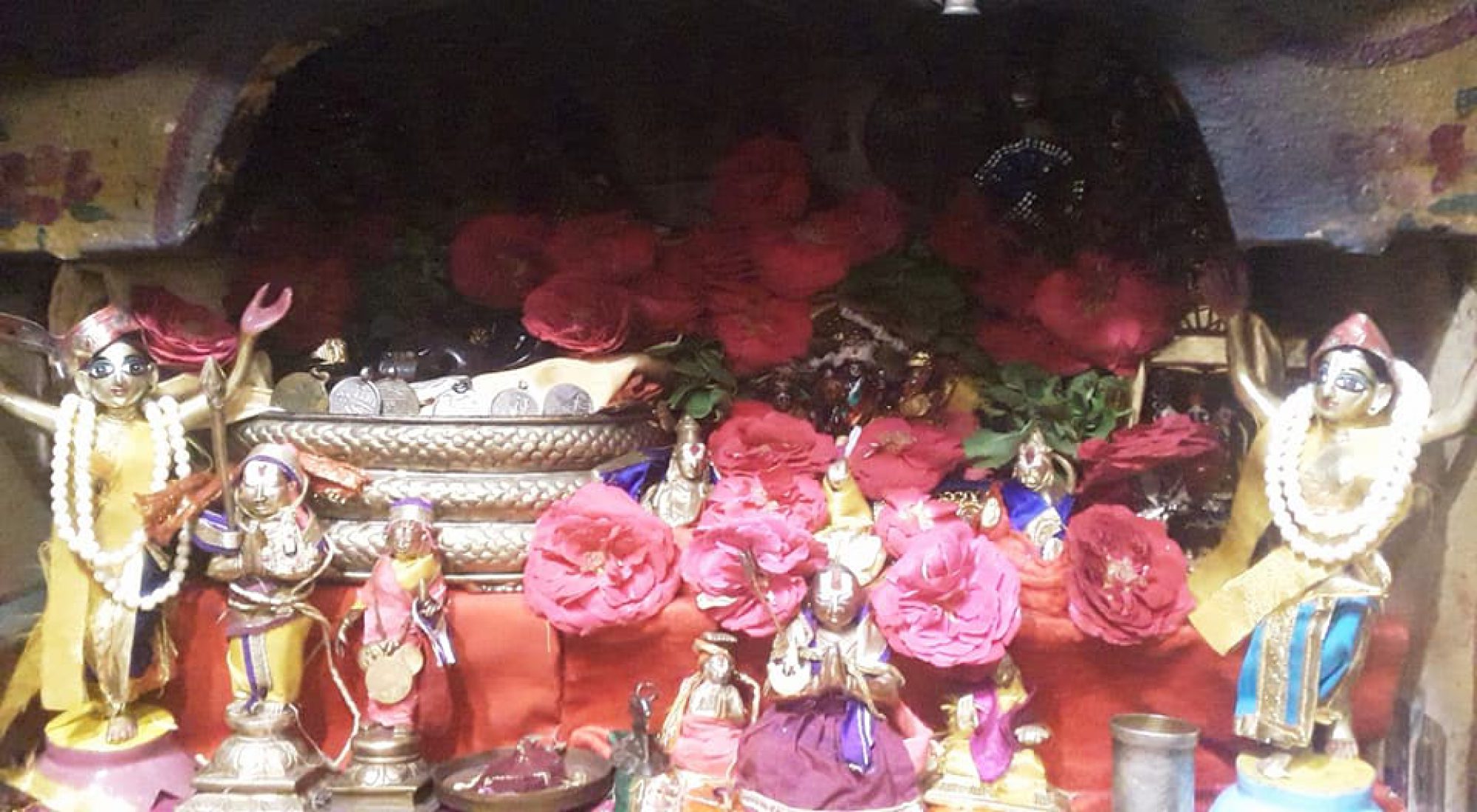

Ahamanna Mahamanna Mahamannam ………Ahamannadohamannaado hamann………………….
The Taittiriya Upanishad forms the seventh, eighth and ninth chapters of the Taittiriya Aranyaka of the Krishna Yajur Veda.

The above verse is taken from Taitriya Upanishad .

Swamy Mudali Andaan ( SriDasarathy ) being an intimate disciple of Swamy Ramanuja and a keen interpreter of Vedanta , used to extract Vedanta in simple terms for a common man to understand mostly in roopa alankara style . Since what follows has a very subtle meaning it has to be patiently understood .

In the above Taitriya Upanishad verse as said
Ahamanna Mahamanna mahamannam Ahamannadohamannaado hamannaadah .
This verse links a jeevatma to the final stage of Liberation . And , Liberation does not mean the union of Jivatma and Paramatma . It is the co living or being together in great happiness like a couple / father / son .

Liberation is both Jivatma and Paramatma are enjoying each other . This is the established quality of Liberation in Visishtaadwaitha . Liberation of the soul means bringing the being to him and experiencing the happiness with him . Lord has made up his mind to relish the jiva . This jiva is in the form of a grain containing chaff called a body . The Acharya secures the grain places it in the pounding stone called Vedanta , powders it with SRAVANA with the pounding stick UPADESA . He patiently removes the chaff thereby creating the knowledge to differentiate between the jiva and atma. He then makes use of a chaff remover called Nidhidhyasanam and removes the chaff called selfishness and ego . Feelings of independence and being apart from the Lord which are in the nature of foreign matter like mud and sand are also removed .

For removing the remnants of sin and vasanas which are sticking to one like bran to the rice , the grain is again pounded in the pounding stone . By this not only is the bran removed , the rice becomes polished with the help of knowledge of SHESHTVA . Now Acharya puts the polished grains in a vessel called SHRADDHA and washed them with the water called PRAPATTI . With the help of the water small sand particles and dirt which are still clinging are filtered and removed .

This filtered grain is poured into a vessel called DEVOTION TO THE LORD , covered with a lid called KNOWLEDGE OF THE LORD and kept over a stove called ” EXPERIENCING THE LOVE OF GOD ” after which the fire of VISHLESHA is lit . For this purpose the firewood called sins committed and yet to be committed is put in the fire which is fanned by a fan called EXPEDITE .

The spillage due to the boil is ANXIETY or EAGERNESS . The love of the Lord is the boil that is achieved . Jiva is now in the form of boiled rice ( Annam ) takes the subtle form and taken through the sushma naadi entrance through the steps of Archiradi which leads to SriVaikuntam where the being is served in a gold plate called the divine body . Lord now joyously partakes the muktaatma called Ahamannam .

The muktaatma when he leaves the world greets the LORD in Srivaikuntam I am becoming Annam to LORD .I am becoming Annam , I am becoming Annam ..In great happiness he says Aham Annam thrice ..in the same way .. and in happiness he also says thrice I am taking food .( Aham Annadaha ) Here Annam means an item which can be enjoyed and satisfaction obtained . Since the purusha is in the form of a son comes to his father and renders service at his shrine , he has enjoyed them the purusha is called Annam and Paramatma is enjoyer and muktha is the Annam . After all the entire effect of creation by the paramatma and his drawing to himself of all the beings is only for the purpose of enjoying them .

Swamy MudaliAndaans Thiru adigale sharanam
Adiyen Ramanuja dasan
Adapted from a discourse shared by an advanced srivaishnavan

video credits : factory display kamalco