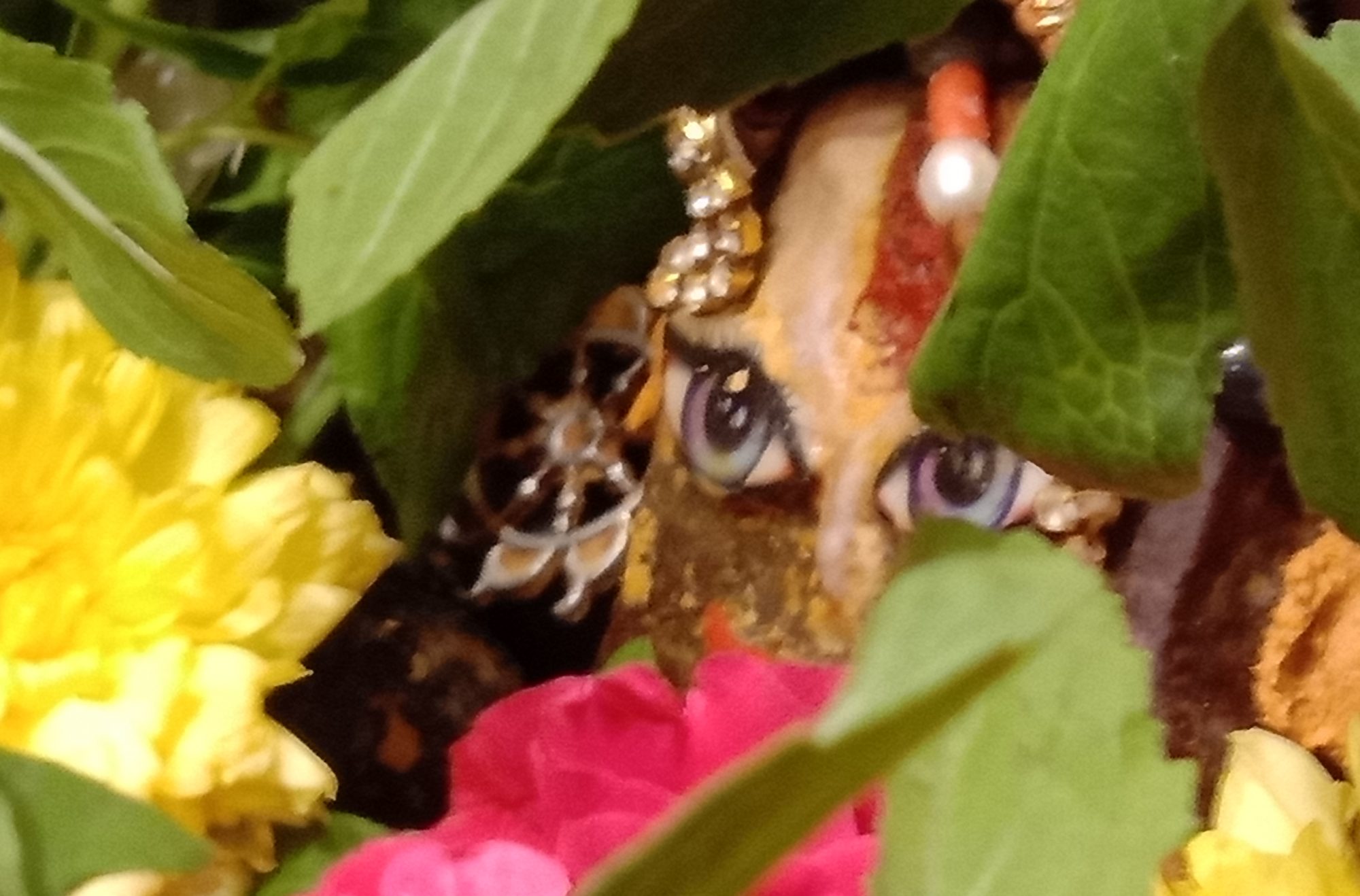
Tears roll continuously …. This day is very special for us , It was a prized darshan … distant dream come TRUE Thanking LORD repeatedly for the mercy praying ardently hearing the vedic chants my eyes look at the divine beauty … Am in a trance suddenly ……….the soul in me rejoices …..Before us stood […]
The revered Azhwars and Acharyars take up upon themselves the burden of saving men who LORD gives up hopelessly for the reluctance in seeking HIM . Do Acharyars really possess these virtue ? An example is quoted from scriptures By a Rishi’s curse a saint was consigned to the nether region , the hellish planets […]
The saints believed that God is within all living beings .An important spiritual practice followed by them was the chanting of Lord’s holy names . Remembering Lord and repeating his Holy Name was most important . Another ingredient for the spiritual life was kirtana or bhajans, the singing of hymns of praise of the Lord […]
Thirukannapuram Divyadesam Sowriraja Perumal Temple is located 30 KM from Kumbakonam on the way to Thiruvarur, Tanjore District, Tamilnadu which is one among the Five Krishraranya Kshetrams. The Main Deity is glorified as Thiru Neelamega perumal along with Sridevi and Bhoodevi Thayar . The Processional deity is worshipped as Lord Sowriraja perumal. Lord Sowriraja […]
The ardent desire of any devotee is to seek an everlasting darshan of Lord Venkateshwara at Tirumala and… If this darshan is without any physical disturbance or interference by the volunteers , the soul dances in ecstasy. There is no dearth of pilgrims who wouldn’t stop gushing about their opportune darshan lasting for even a fraction of second […]
Originally posted on kazhiyur varadan’s blog: Swamy Nampillai was the fourteenth Acharya in the prestigious Guruparampara lineage of Srivaishnava sampradaya . One day Swamy Nampillai asked his Acharya Nan Jeeyar the most relevant question of present day. He submitted to his Acharyar humbly and asked Swamin !! How can one confirm that he has… Characteristics……
A divine pastime happened few hundreds year ago near the banks of Cauvery river. One sunny day few srivaishnava boys were playing on the banks of Cauvery river . As they inherited their parents daily rituals , the boys smartly erected a small temple and installed an idol out of the Cauvery mud from the […]
Nallan was a disciple of Swamy Ramanuja .He was an ardent devotee of LORD VARADAR at Kancheepuram . Attending classes at Ashram of Swamy Ramanuja , his bhakthi towards Lord Varadar increased manifold . Any services for his Acharyar was cheerfully obeyed . Once it so happened , Swamy Ramanuja had to leave Kancheepuram on […]
LORD RAMA ANSWERS A BRITISHER’S PRAYER It was during the period 1795 to 1799 a British officer called Colonel Lionel Blazehe was Collector of Chengalpattu District . Colonel Lionel on his routine survey had witnessed two cracks to the huge tank in Madurantakam taluk. The enormity of the problem can be appreciated only when we……
Appearance day of “Lalitha Sakhi ” is Sashti” which occurs two days before Radhashtami. She appeared at a place called Karhela to Visokha and Sarada devi . Her parents later shifted to Ooncha gaon where there is a big temple dedicated to her. Ooncha gaon is 2 kms from Barsaana.
Its always a pure devotee who wins by his bhakthee and Lord always proves this repeatedly that HIS bhaktha is dearest to HIM . Bhakthisarar Thiruvadigale sharanam
Villidasan instantly fell in love with those large, beautiful eyes, for which nothing in the world is even a pale comparison. Villi prostrated at Sri Ramanujar’s feet proclaiming his slavery to the saint. …………………https://kazhiyurvaradansblog.co.in/2015/08/26/the-wrestler-and-the-most-beautiful-eyes-2/
Once , Swamy Ramanuja proceeds along with his disciples to Azhwar Tirunagari near Thirunelvelli , the appearance place of Swamy Nammazhwar and offers his obeisances to Lord Aadi deva perumal . Further he proceeds towards Thirukkolur with the object of having darshan of Lord Vaithamanidhi Perumal . Divyakavi Pillai Iyengar in 108 Tirupati Andhadhi […]
Amongst the several revered disciples of Jagath Acharyar Swamy Ramanujar Swami AmudhanAr earlier known as Peria Koil Nambi was transformed disciple of JagathaAcharyar . Nambi appeared in “mungirkkudi” on Panguni Hastham day in Srirangam which coincides to be today March 22 2019. He became the most dearest disciple of Swamy Ramanuja . However […] […]
venkaTAdri samam sthAnam brahmANDe nAsti kincana; venkateSa samo devo na bhUto na bhaviSyati This sloka taken from the Puranas claims ………… There is no place in the entire universe that equals Venkatadri, the place where the Lord resides and there is no God, neither in the past nor in the future who equals Lord Venkateswara. Everything begins and ends […]
When protecting Perumal became the only purpose of a life
After walking back to the world from the experiences of my Acharya Yāthirai, I found myself looking again at the road I had travelled.
There were so many Acharyas.
So many lives.
So many ways in which a human being could surrender his entire existence to the service of the Lord.
But one name kept coming back to me.
Swamy Piḷḷai Lokācārya.
I had already heard his name many times.
I had even travelled to places connected with him.
But perhaps hearing about an Acharya and standing before the memories of his life are two very different things.
During my Yāthirai, I had the fortune of having darshan of Swamy Piḷḷai Lokācārya at Srirangam, at Jyothishkudi, where he is traditionally associated with leaving this world, and later at Melkote.
Yet I still feel that I have understood very little.
Perhaps that is how it should be.
The more I learn about our Acharyas, the more I realise how little I know.
A day of celebration that suddenly changed
One of the episodes I came across while trying to understand the life of Swamy Piḷḷai Lokācārya left a deep impression on me.
It was a festive occasion at Srirangam.
The atmosphere was filled with devotion.
The Lord was about to arrive for the ceremonial worship.
Milk, curd, honey, coconut water, rose water, sandal preparations, perfumes, flowers and tulasi garlands had all been arranged.
The devotees were waiting eagerly.
Among the Acharyas present was Swamy Vedanta Desika, along with Swamy Sudarshana Suri and several others.
And then I noticed something in the account that touched me deeply.
There was an elderly devotee standing among that great gathering.
He was not thinking about himself.
He was looking at the Lord.
And as he stood there, his thoughts turned towards all those devotees who had served Perumal through the ages.
Jatayu.
Vidura.
Thiruppān Āḻvār.
Lokasāranga Muni.
Kulasekhara Āḻvār.
Periya Nambi.
Māranēri Nambi.
Rāmānuja.
Thirukkacchi Nambi.
His heart was overflowing with gratitude.
And he wondered within himself:
“What have I done for the Lord?”
He had forgotten everything around him.
He was simply immersed in the Lord’s presence.
That person, according to the account I read, was our Jagadāchārya Swamy Piḷḷai Lokācārya.
I paused there for a long time.
What kind of heart must one have to stand in the middle of such greatness and still ask:
“What have I done for the Lord?”
I looked at myself.
And I had to ask the same question.
Then came the warning
Suddenly, a man came running towards the Acharya.
He was frightened.
He had been washing clothes on the banks of the Cauvery when his donkeys suddenly ran away after hearing an unusual sound.
He had climbed a small hillock to see what had frightened them.
And what he saw terrified him.
A large army was approaching.
The news of invasions and destruction of temples had already begun spreading.
He came to the Acharya and asked in fear:
“What will happen to our temple? What will happen to Lord Ranganatha?”
I found Swamy Lokācārya’s response deeply moving.
He did not panic.
He did not think of his own safety first.
He simply turned towards the Lord, offered his obeisance and placed his trust in Him.
“Do not worry. Our Lord will take care.”
Then he asked the man to continue his normal work but to keep watching the movements of the invading army and report back.
What a lesson.
Faith does not always mean doing nothing.
Sometimes faith gives us the courage to do exactly what has to be done.
The impossible decision
Swamy Lokācārya, Swamy Desika, Swamy Sudarshana Suri and the other Acharyas understood the seriousness of the situation.
They knew that the temple could be attacked.
The Lord’s sacred presence had to be protected.
The objective was not to fight the invading army.
The objective was much simpler.
Perumal must not be desecrated.
Three groups were formed.
One group would take the Lord’s deity away towards the south.
Another would take measures to protect the sanctum.
The third would move in another direction with sacred texts and the responsibility of preserving the teachings.
I was struck by the thought that these Acharyas were not merely preserving stone structures.
They were preserving a living tradition.
They were protecting the Lord’s worship.
They were protecting the granthas.
They were protecting the knowledge received from their Acharyas.
And they were protecting something that did not belong to them personally.
It belonged to generations yet unborn.
Carrying Ranganatha
Swamy Piḷḷai Lokācārya took the responsibility of accompanying Lord Ranganatha.
What followed was not a comfortable pilgrimage.
There were no roads as we know them today.
No vehicles.
No secure accommodation.
No certainty about food.
No knowledge of what danger might appear around the next corner.
They travelled hundreds of miles.
There was always the possibility of attack.
There were robbers.
There was hunger.
There was exhaustion.
And yet the Acharya remained concerned about one thing.
The Lord’s daily worship must not stop.
The account describes him carrying the deity with the greatest care and ensuring that the traditional worship continued despite all the difficulties.
I read that again.
The Lord whom we approach today with folded hands…
The Lord whom we ask to protect us…
Was being carried and protected by His devotee.
It almost sounds strange when we say it aloud.
How can the Supreme Lord need protection?
Perhaps He did not.
Perhaps He chose to accept the protection of His devotee so that the world could witness what devotion really means.
I am only sharing what I felt while reading this.
I do not know the deeper meaning.
But that thought stayed with me.
Jyothishkudi
The journey eventually brought them to Jyothishkudi, surrounded by mountains and dense forests.
By then Swamy Lokācārya was physically exhausted.
His body had suffered enormously.
The account says that even while injured and completely tired, his concern remained with Lord Ranganatha.
And then came the moment that broke my heart.
The Acharya realised that his time on earth was coming to an end.
He was surrounded by his disciples.
He looked at Perumal.
Swamy Pillai Lokacharya
The Lord Himself appeared tired after the long journey.
And the Acharya asked his disciples to fan the Lord.
Imagine that scene.
An Acharya whose own body was exhausted.
An Acharya who had suffered injuries.
An Acharya who knew that he was about to leave this world.
And even then his thought was:
“Perumal is tired. Please fan Him.”
What was left of his life belonged to the Lord.
Not to himself.
Even the ants
Then I came across another part of the traditional account which touched me in a completely different way.
The place was filled with ants.
Swamy Lokācārya saw them.
He touched them.
The traditional account associates this with the belief that those touched by a great Sri Vaishnava receive the Lord’s grace and attain liberation.
Whether I can understand the depth of such an act is another matter.
But I could understand one thing.
His compassion did not stop with human beings.
Even in his final moments, his heart was turned towards other living beings.
And suddenly the name Lokācārya seemed to acquire a different meaning for me.
The universal Acharya.
What did I learn?
I have read about great scholars.
I have read about Acharyas who defeated great philosophers.
I have read about those who composed extraordinary granthas.
I have admired their knowledge.
But Swamy Piḷḷai Lokācārya made me look at another form of greatness.
Service without asking what I will receive.
I keep asking Perumal for protection.
He showed me an Acharya who spent his last strength protecting Perumal.
I ask for comfort.
He walked through forests carrying the Lord.
I worry about my small difficulties.
He faced dangers that I can hardly imagine.
I sometimes wonder whether Perumal has remembered me.
But the Acharya’s life makes me ask a different question:
Have I remembered Perumal when He needed my service?
Perhaps that is where the mirror has turned towards me again.
My three darshans
During my Yāthirai, I made sure to have darshan of Swamy Piḷḷai Lokācārya at three places.
Srirangam.
Jyothishkudi.
Melkote.
At Jyothishkudi especially, I stood there thinking about the journey that had taken place centuries ago.
The forests.
The fear.
The exhaustion.
The Lord being carried from place to place.
And finally the Acharya leaving his body.
I stood there quietly.
I could not think of anything profound to say.
Only one prayer came.
“Swamy, please teach me to serve.”
Not to become great.
Not to be recognised.
Not even to understand everything.
Just to learn how to serve.
The interest that later grew in me to read the eighteen Rahasyas of Swamy Piḷḷai Lokācārya also feels, in retrospect, like another small mercy of the Acharya.
Walking with the Acharyas
As I continue this journey, I am beginning to understand why I do not want to write these posts as though I am explaining the great Acharyas.
Who am I to explain them?
I am only walking behind them.
Sometimes I see a footprint.
Sometimes a signpost.
Sometimes a story.
Sometimes a word from a grantha.
And sometimes, during a pilgrimage, I stand at the very place where something happened and feel my eyes becoming wet.
That is enough for me.
Swamy Piḷḷai Lokācārya has left me with one question that I cannot easily escape:
If everything I have belongs to Perumal, what have I really done in His service?
Perhaps that question itself is another step on my journey within.
Oh ! Lord Sreenivasaa
When I ask You to protect me,
teach me to remember those who protected Your kainkaryam.
When I ask You for comfort,
teach me to remember those who carried You through hardship.
When I become anxious about my own little problems,
bring before my eyes the life of Swamy Piḷḷai Lokācārya.
Let me not merely admire our Acharyas.
Let me learn one small virtue from them.
Let me become a little less concerned about myself.
Let me become a little more useful to Your devotees.
And when my journey finally comes to an end,
may I have at least one small answer to the question:
“What have you done for the Lord?”
Śrīmate Rāmānujāya Namaḥ
Adiyen Rāmānujadāsan
Pictures : Courtesy Google Images
to be continued
Previous posts of the above series is appended in the below links
There comes a moment in every journey when we have to turn back.
The road that took us away from home slowly brings us back.
The temples become memories.
The darshan becomes something we carry in our hearts.
The voices of the priests become distant echoes.
The prasādam lovingly offered by someone we had never met is already gone.
And yet, something remains.
Something that cannot be packed into a suitcase.
Something that cannot be photographed.
Something that quietly follows us home.
That is how I felt when my Āchārya Yāthirai began to come to an end.
I was walking back to my ordinary life.
But I did not feel quite the same person who had started the journey.
I had gone looking for them
I had travelled to places where our Āchāryas had lived, worshipped, taught and served.
I had stood before the sannidhis of great personalities whose names I had heard all my life.
I had entered Thirumaligais.
I had sat before priests and elders.
Sometimes I had gone with a specific question.
Sometimes I had gone simply because my heart wanted to see the place.
And many times, I received much more than I expected.
A priest would open a door.
Someone would offer prasādam.
An elderly person would narrate a pastime.
A young Archakar would patiently answer my questions.
A garland would somehow come into my hands.
A few words would remain in my mind for days.
Looking back, I wonder whether these were really coincidences.
Or whether the Āchāryas were simply being kind to a very ordinary seeker.
The road behind me
As I travelled back, my mind began walking through the Yāthirai again.
I remembered Srirangam.
I remembered the many Thirumaligais.
I remembered Periya Nambi.
Parasara Bhattar.
Nampiḷḷai.
Piḷḷai Āthan.
Piḷḷai Lokācārya.
Koorathāḻvān.
Swamy Rāmānuja.
And so many others whose lives I had been trying to understand.
Each story seemed to have left something behind.
One showed me humility.
Another showed me service.
Another showed me Bhāgavatha prema.
Another showed me the danger of ego.
Another showed me what it means to put Perumāḷ before one’s own life.
I had begun the Yāthirai thinking that I was collecting stories.
Slowly, I realised that the stories were collecting me.
They were entering somewhere deep inside.
What had I really gained?
I asked myself this question while returning.
Had I become a great scholar?
No.
Had I suddenly understood our granthas?
No.
Had all my weaknesses disappeared?
Certainly not.
If anything, I had become more conscious of them.
And strangely, that itself felt like a blessing.
Earlier, I might have looked at an Āchārya and simply admired him.
Now I was beginning to ask:
What is there in his life that I am supposed to learn?
That was a completely different question.
The Yāthirai had slowly changed the question inside me.
I had started by asking:
“What can I see?”
Now I was asking:
“What can I become?”
From the Āchāryas to the Āḻvārs
And then, somewhere along the return journey, another thought began to grow.
I had spent so much time travelling to the places of the Āchāryas.
But where did the treasure they protected come from?
What was the source of the Divya Prabandham they treasured?
Whose words had inspired them?
Whose pasurams had they preserved, taught and carried from generation to generation?
The answer was waiting for me.
The Āḻvārs.
Perhaps the road was now asking me to turn back even further.
Back to the source.
Back to those extraordinary souls whose hearts melted in their love for Perumāḷ.
A place I could not forget
One of the places that began to occupy my thoughts was Āḻvār Tirunagari.
We had travelled there as part of our Āchārya Yāthirai.
The place itself had a different atmosphere.
The quiet Tamiraparani flowed nearby.
We took a dip in the river, remembering the great devotees associated with its banks.
But our real destination was Śrī Rāmānuja Chaturvedi Maṅgalam.
I wanted to have darshan of the Bhaviṣyad Āchārya associated with Swamy Rāmānuja.
The priest narrated the beautiful traditional account connected with Madhurakavi Āḻvār and Swamy Nammāḻvār, and how this sacred place came to be associated with Rāmānuja even before his appearance.
I stood there listening.
My children were also eager to hear the story.
And I suddenly felt that something very special was happening.
I had come looking for Rāmānuja.
But Rāmānuja was taking me back to Nammāḻvār.
That thought stayed with me.
A chain of love
The more I listened, the more beautiful the connection seemed.
Nammāḻvār.
Madhurakavi Āḻvār.
Rāmānuja.
The Āchāryas who came after him.
And now, generations later, a simple seeker like me standing in that same sacred atmosphere.
I began to see something that I had perhaps never understood before.
The sampradāya was not simply a succession of names.
It was a living chain of love and service.
One generation received.
One generation preserved.
One generation passed it on.
And another generation received it again.
I was standing at the far end of that long chain, wondering whether I had done anything worthy of what had been handed down to me.
The question that followed me home
I remembered the words that had touched me so often during this Yāthirai.
What have I done for the Lord?
That question now seemed to take on another meaning.
I had received so much.
The Divya Prabandham.
The teachings of the Āchāryas.
The stories of the Bhāgavathas.
The opportunity to visit Divya Desams.
The opportunity to sit before learned devotees.
The opportunity to hear the words of our elders.
What had I given back?
Perhaps very little.
And yet, perhaps the Lord does not ask us to become great.
Perhaps He asks us simply to preserve what we have received and pass a little of it forward.
Walking back to earth
The journey was ending.
The car was moving towards home.
The temples were disappearing behind me.
The familiar roads were returning.
My ordinary life was waiting.
But something had changed.
I had gone looking for the footprints of the Āchāryas.
I returned carrying their stories.
I had gone looking at their places.
I returned looking at myself.
And now the road was quietly pointing somewhere else.
Towards the Āḻvārs. Towards Nammāḻvār.
Towards those divine pasurams that had inspired the very Āchāryas whose lives had just humbled me.
Perhaps this was not the end of the Yāthirai after all.
Perhaps I had merely reached another bend in the road.
*
The road turns
There is something deeply moving about this to me.
I had started this journey with Swamy Rāmānuja.
His name had awakened something in me.
His temples drew me towards him.
His life made me search.
His devotees taught me.
His Āchāryas showed me mirrors.
And now, after walking through that world, I was being led back to the person whom Rāmānuja himself revered so deeply.
Swamy Nammāḻvār.
Perhaps the road had come full circle.
Or perhaps it was only beginning to reveal where it wanted to take me.
I do not know.
I am only walking.
Looking at the signposts left behind by our Āchāryas.
Trying to understand them.
Trying to follow them.
And hoping that somewhere along the way, I may become a little less of myself and a little more worthy of the path they showed us.
A small prayer
Oh Lord Sreenivasaa
Thank You for the Yāthirai.
Thank You for every temple.
Every priest.
Every devotee.
Every Āchārya.
Every story.
Every unexpected kindness.
Please don’t let them remain only beautiful memories.
Let them slowly become part of my life.
I went looking for the places where the Āchāryas walked.
You made me look at the way I walk.
I went looking for their stories.
You made me ask what I am doing with the story of my own life.
And now, as I turn towards the Āḻvārs, please give me the humility to listen.
Let me not approach their pasurams merely as poetry.
Let me try to understand the love that poured through them.
The road has brought me back to earth.
But perhaps…
the journey within has only just begun.
To be continued
Śrīmate Rāmānujāya Namaḥ
Adiyen Rāmānujadāsan
Pictures : Courtesy Google Images
Previous posts of the above series is appended in the below links
The ardent desire of any devotee is to seek an everlasting darshan of Lord Venkateshwara at Tirumala and… If this darshan is without any physical disturbance or interference by the volunteers , the soul dances in ecstasy. There is no dearth of pilgrims who wouldn’t stop gushing about their opportune darshan lasting for even a fraction of second […]