
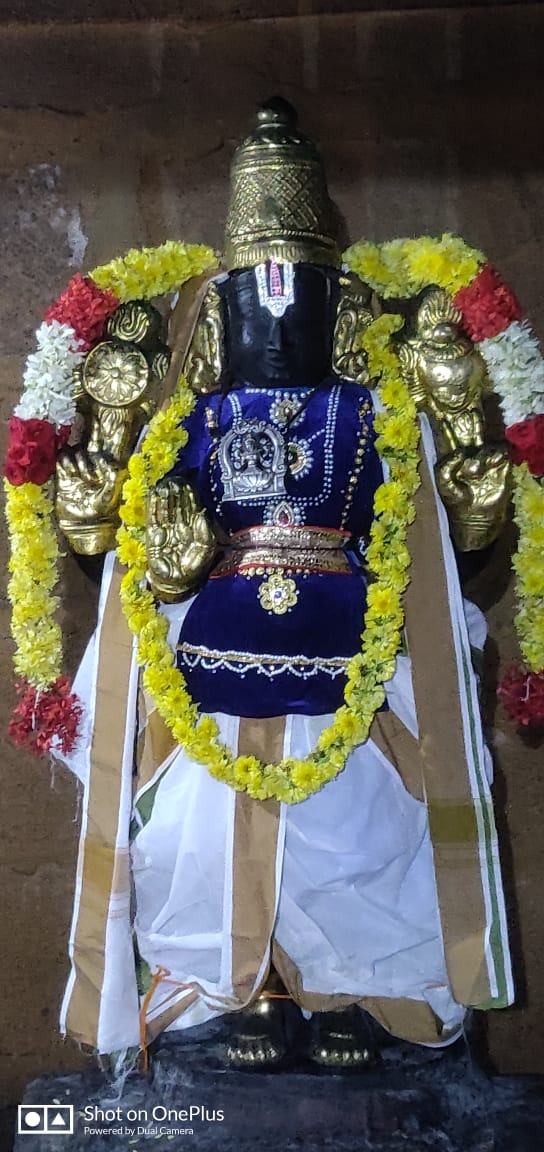

THE ACHARYA WHO CARRIED THE LORD
When protecting Perumal became the only purpose of a life
After walking back to the world from the experiences of my Acharya Yāthirai, I found myself looking again at the road I had travelled.
There were so many Acharyas.

So many lives.
So many ways in which a human being could surrender his entire existence to the service of the Lord.
But one name kept coming back to me.
Swamy Piḷḷai Lokācārya.
I had already heard his name many times.
I had even travelled to places connected with him.

But perhaps hearing about an Acharya and standing before the memories of his life are two very different things.
During my Yāthirai, I had the fortune of having darshan of Swamy Piḷḷai Lokācārya at Srirangam, at Jyothishkudi, where he is traditionally associated with leaving this world, and later at Melkote.
Yet I still feel that I have understood very little.
Perhaps that is how it should be.
The more I learn about our Acharyas, the more I realise how little I know.
A day of celebration that suddenly changed
One of the episodes I came across while trying to understand the life of Swamy Piḷḷai Lokācārya left a deep impression on me.
It was a festive occasion at Srirangam.
The atmosphere was filled with devotion.
The Lord was about to arrive for the ceremonial worship.
Milk, curd, honey, coconut water, rose water, sandal preparations, perfumes, flowers and tulasi garlands had all been arranged.
The devotees were waiting eagerly.
Among the Acharyas present was Swamy Vedanta Desika, along with Swamy Sudarshana Suri and several others.
And then I noticed something in the account that touched me deeply.
There was an elderly devotee standing among that great gathering.
He was not thinking about himself.
He was looking at the Lord.
And as he stood there, his thoughts turned towards all those devotees who had served Perumal through the ages.
Jatayu.
Vidura.
Thiruppān Āḻvār.
Lokasāranga Muni.
Kulasekhara Āḻvār.
Periya Nambi.
Māranēri Nambi.
Rāmānuja.
Thirukkacchi Nambi.
His heart was overflowing with gratitude.
And he wondered within himself:

“What have I done for the Lord?”
He had forgotten everything around him.
He was simply immersed in the Lord’s presence.
That person, according to the account I read, was our Jagadāchārya Swamy Piḷḷai Lokācārya.
I paused there for a long time.
What kind of heart must one have to stand in the middle of such greatness and still ask:
“What have I done for the Lord?”

I looked at myself.
And I had to ask the same question.
Then came the warning
Suddenly, a man came running towards the Acharya.
He was frightened.
He had been washing clothes on the banks of the Cauvery when his donkeys suddenly ran away after hearing an unusual sound.
He had climbed a small hillock to see what had frightened them.
And what he saw terrified him.
A large army was approaching.
The news of invasions and destruction of temples had already begun spreading.
He came to the Acharya and asked in fear:

“What will happen to our temple? What will happen to Lord Ranganatha?”
I found Swamy Lokācārya’s response deeply moving.
He did not panic.
He did not think of his own safety first.
He simply turned towards the Lord, offered his obeisance and placed his trust in Him.
“Do not worry. Our Lord will take care.”
Then he asked the man to continue his normal work but to keep watching the movements of the invading army and report back.
What a lesson.
Faith does not always mean doing nothing.
Sometimes faith gives us the courage to do exactly what has to be done.
The impossible decision
Swamy Lokācārya, Swamy Desika, Swamy Sudarshana Suri and the other Acharyas understood the seriousness of the situation.
They knew that the temple could be attacked.
The Lord’s sacred presence had to be protected.
The objective was not to fight the invading army.
The objective was much simpler.
Perumal must not be desecrated.

Three groups were formed.
One group would take the Lord’s deity away towards the south.
Another would take measures to protect the sanctum.
The third would move in another direction with sacred texts and the responsibility of preserving the teachings.
I was struck by the thought that these Acharyas were not merely preserving stone structures.
They were preserving a living tradition.
They were protecting the Lord’s worship.
They were protecting the granthas.
They were protecting the knowledge received from their Acharyas.
And they were protecting something that did not belong to them personally.
It belonged to generations yet unborn.

Carrying Ranganatha
Swamy Piḷḷai Lokācārya took the responsibility of accompanying Lord Ranganatha.
What followed was not a comfortable pilgrimage.
There were no roads as we know them today.
No vehicles.
No secure accommodation.
No certainty about food.
No knowledge of what danger might appear around the next corner.
They travelled hundreds of miles.
There was always the possibility of attack.
There were robbers.
There was hunger.
There was exhaustion.
And yet the Acharya remained concerned about one thing.
The Lord’s daily worship must not stop.
The account describes him carrying the deity with the greatest care and ensuring that the traditional worship continued despite all the difficulties.
I read that again.
The Lord whom we approach today with folded hands…
The Lord whom we ask to protect us…
Was being carried and protected by His devotee.
It almost sounds strange when we say it aloud.
How can the Supreme Lord need protection?
Perhaps He did not.
Perhaps He chose to accept the protection of His devotee so that the world could witness what devotion really means.
I am only sharing what I felt while reading this.
I do not know the deeper meaning.
But that thought stayed with me.
Jyothishkudi

The journey eventually brought them to Jyothishkudi, surrounded by mountains and dense forests.
By then Swamy Lokācārya was physically exhausted.
His body had suffered enormously.
The account says that even while injured and completely tired, his concern remained with Lord Ranganatha.
And then came the moment that broke my heart.
The Acharya realised that his time on earth was coming to an end.
He was surrounded by his disciples.
He looked at Perumal.

The Lord Himself appeared tired after the long journey.
And the Acharya asked his disciples to fan the Lord.
Imagine that scene.
An Acharya whose own body was exhausted.
An Acharya who had suffered injuries.
An Acharya who knew that he was about to leave this world.
And even then his thought was:
“Perumal is tired. Please fan Him.”
What was left of his life belonged to the Lord.
Not to himself.

Even the ants
Then I came across another part of the traditional account which touched me in a completely different way.
The place was filled with ants.
Swamy Lokācārya saw them.
He touched them.
The traditional account associates this with the belief that those touched by a great Sri Vaishnava receive the Lord’s grace and attain liberation.
Whether I can understand the depth of such an act is another matter.
But I could understand one thing.

His compassion did not stop with human beings.
Even in his final moments, his heart was turned towards other living beings.
And suddenly the name Lokācārya seemed to acquire a different meaning for me.
The universal Acharya.
What did I learn?

I have read about great scholars.
I have read about Acharyas who defeated great philosophers.
I have read about those who composed extraordinary granthas.
I have admired their knowledge.
But Swamy Piḷḷai Lokācārya made me look at another form of greatness.
Service without asking what I will receive.
I keep asking Perumal for protection.
He showed me an Acharya who spent his last strength protecting Perumal.
I ask for comfort.

He walked through forests carrying the Lord.
I worry about my small difficulties.
He faced dangers that I can hardly imagine.
I sometimes wonder whether Perumal has remembered me.
But the Acharya’s life makes me ask a different question:
Have I remembered Perumal when He needed my service?
Perhaps that is where the mirror has turned towards me again.
My three darshans

During my Yāthirai, I made sure to have darshan of Swamy Piḷḷai Lokācārya at three places.
Srirangam.
Jyothishkudi.
Melkote.
At Jyothishkudi especially, I stood there thinking about the journey that had taken place centuries ago.
The forests.
The fear.
The exhaustion.
The Lord being carried from place to place.
And finally the Acharya leaving his body.
I stood there quietly.

I could not think of anything profound to say.
Only one prayer came.
“Swamy, please teach me to serve.”
Not to become great.
Not to be recognised.
Not even to understand everything.
Just to learn how to serve.
The interest that later grew in me to read the eighteen Rahasyas of Swamy Piḷḷai Lokācārya also feels, in retrospect, like another small mercy of the Acharya.

Walking with the Acharyas
As I continue this journey, I am beginning to understand why I do not want to write these posts as though I am explaining the great Acharyas.
Who am I to explain them?
I am only walking behind them.
Sometimes I see a footprint.
Sometimes a signpost.
Sometimes a story.
Sometimes a word from a grantha.

And sometimes, during a pilgrimage, I stand at the very place where something happened and feel my eyes becoming wet.
That is enough for me.
Swamy Piḷḷai Lokācārya has left me with one question that I cannot easily escape:
If everything I have belongs to Perumal, what have I really done in His service?
Perhaps that question itself is another step on my journey within.
Oh ! Lord Sreenivasaa
When I ask You to protect me,
teach me to remember those who protected Your kainkaryam.
When I ask You for comfort,
teach me to remember those who carried You through hardship.
When I become anxious about my own little problems,
bring before my eyes the life of Swamy Piḷḷai Lokācārya.
Let me not merely admire our Acharyas.
Let me learn one small virtue from them.
Let me become a little less concerned about myself.
Let me become a little more useful to Your devotees.
And when my journey finally comes to an end,
may I have at least one small answer to the question:
“What have you done for the Lord?”
Śrīmate Rāmānujāya Namaḥ
Adiyen Rāmānujadāsan
Pictures : Courtesy Google Images
to be continued
Previous posts of the above series is appended in the below links
